
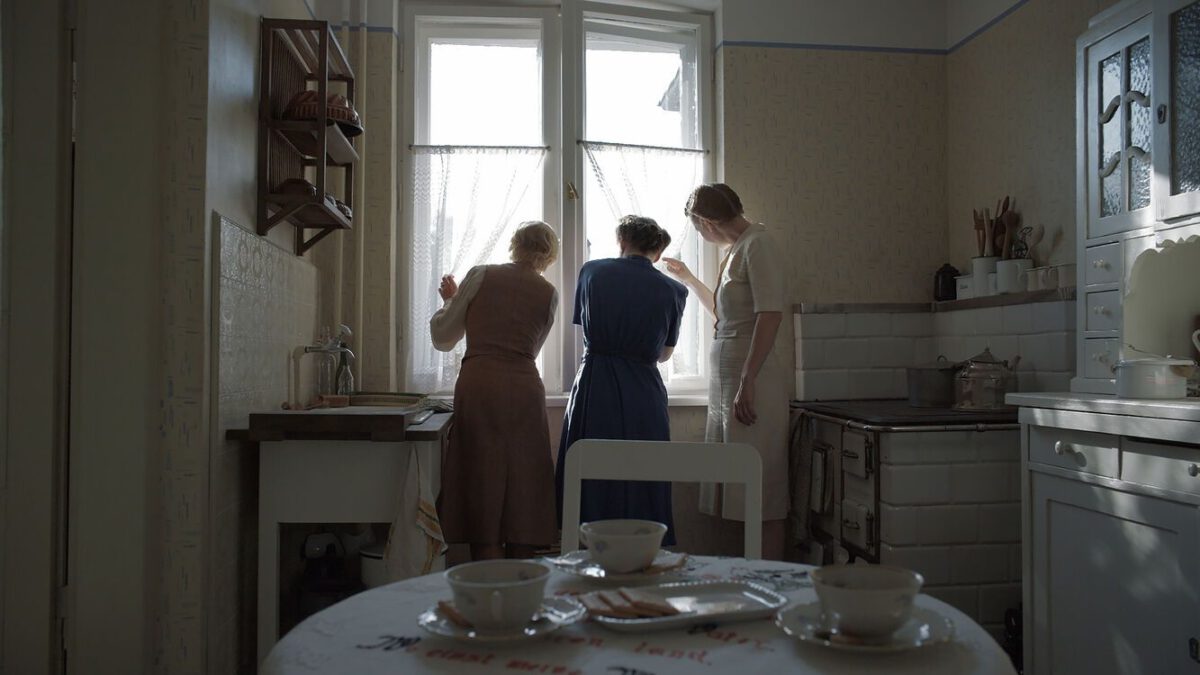
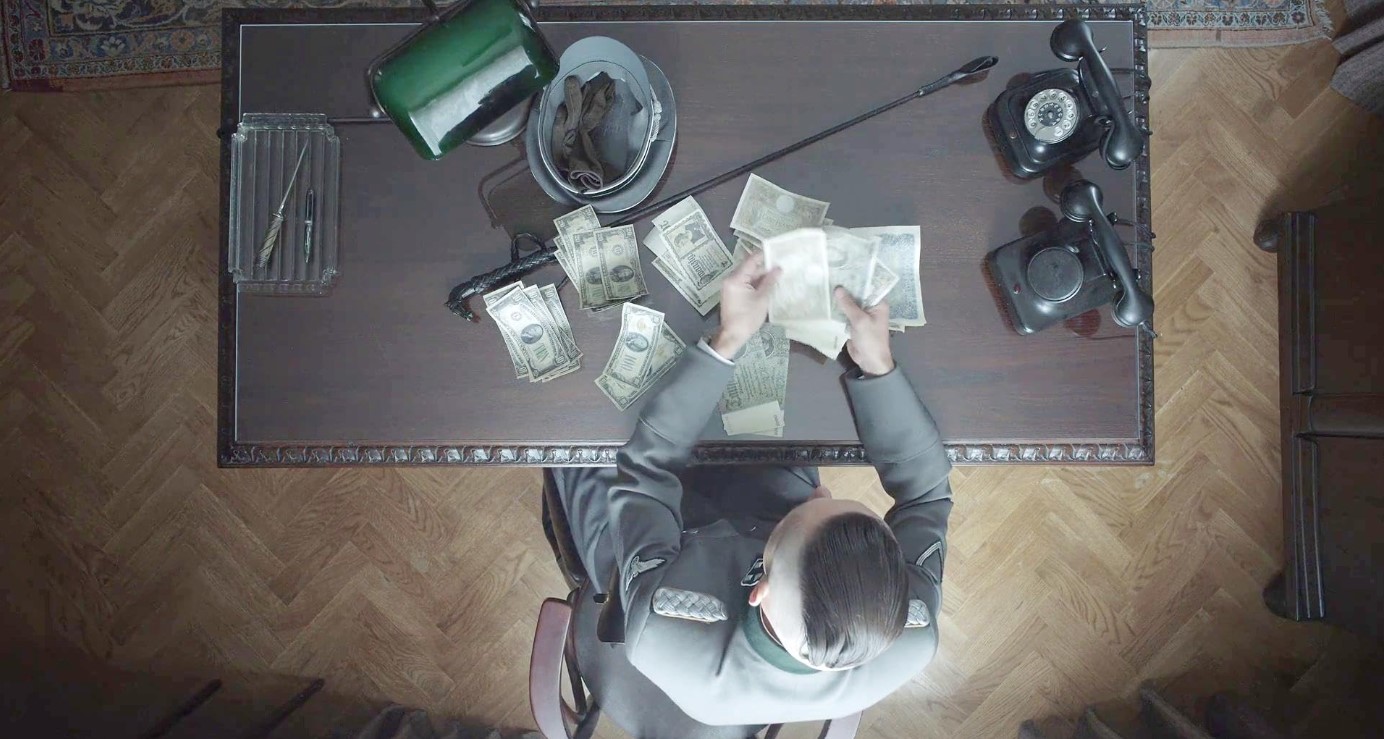
Interest is, among other things, a business, an accounting term, and a strictly capitalist one at that – as in interest rate. There are also business interests. Jonathan Glazer consciously follows the footsteps of classical Marxist analyses dissecting Nazism and the crimes of the Third Reich as an extreme fulfilment of the capitalist rationale (see Adorno and Horkheimer, Traverso, etc.) where people are exploited until depleted of life and productive energy, and then utilized like some raw material waste. In The Zone of Interest, we can see the concentration camp as a horrifying economic unit.
Concentration camp as an economic unit, subject to capitalist efficiency requirements, is one thing. Third Reich is also presented as a way of managing capitalism in conditions of its profound, structural crisis, at least on a specific, militarily conquered and controlled territory. It’s a predatory and parasitic economy, able to make some people rich only by depriving others of their life and property (think of the Nazi officers’ wives talking about clothes they have taken away from Jewish women).
Un-Interest
There is also interest as in being interested. Glazer’s film is perversely about shunning away from being interested, about a life in a state of conscious un-interest, about being comfortable while not being interested to care. Like, for example care about monstrous crimes which are routinely committed on industrial scale just under your nose. These crimes that no one has any interest in caring about, are precisely the source or necessary condition of prosperity for some.
Some call Glazer’s The Zone of Interest a “loose adaptation” of the namesake Martin Amis’ novel, but it’s not exactly true. Glazer liked the original title: it referred to das Interessegebiet, meaning the area directly adjacent to the camp’s wall, on the outside. That’s where the family house of Auschwitz commandant Rudolf Höss (Christian Friedel) is. Though the German term is frozen in its peculiar meaning in the field of 20th century historiography, it is also potentially ambiguous, for meanings of das Interesse range from interest rate to quality or state of being interested.
Instead of adapting the eponymous novel, Glazer researched historical prototypes of some characters that Amis put in fictionalised costumes, as well as the sources of inspiration for the novelist. In a way he had jumped over Amis’ book, getting closer to the root. In Oświęcim – (the name of Auschwitz in Polish) he managed to find persons who still remembered the Höss family and their house, even worked there.
Memory of the Holocaust
During the press conference at the Cannes festival, where the film premiered, Glazer articulated his conviction that generation by generation, we have to seek new ways of retelling Hitler’s genocide of European Jews. In following months, he reiterated this point repeatedly (even though at times he also stresses his distrust about intentions of those making another Holocaust movie).
I disagree with Glazer. I don’t believe that there is any need to endlessly multiply representations of Hitlerian genocide of European Jews, which I personally, after Arno Mayer, prefer to call Judeocide rather than the Holocaust. Esther Benbassa, historian and a member of the French Senate, in her book Suffering as Identity proposed to move the Holocaust from the realm of memory to its place in the realm of history. She stipulates it out of conviction that memory is the enemy of history. Depending on emotions, memory must continuously stimulate itself, using more and more powerful incentives (therefore Holocaust movies and Holocaust literature compete by means of increasingly shocking representations of perverse violence).
Not only “memory of the Holocaust” does not protect us from repeating history – as it is claimed by believers of this somber cult – but it may as well be preparing the ground for such a repetition. Noam Chayut, one of the founders of Breaking the Silence, an NGO that unites former Israeli soldiers who regained their conscience and now document war crimes and crimes against humanity committed by the Israeli military, had titled his exceptional and moving memoir The Girl Who Stole My Holocaust. An accusatory gaze of a harmed Palestinian child had shaken Chayut when he was busy with just the usual daily Israeli soldiers’ thing: abusing random Palestinians, taking part in the perpetuation of never-ending crimes of the Israeli state of a permanent occupation and an apartheid regime. Chayut managed to show in his book – starting with its title – how the increasingly cynical “memory of the Holocaust” religion turns the Nazi genocide of European Jews into some sort of a “treasure”. A “treasure” that is then internalised by everyone brought up in the State of Israel. A “treasure” that is meant to establish Jewish exceptionality and finally be a source of the right to harm and even kill, without any punishment, all those who don’t carry it within themselves.
On one level, “memory of the Holocaust” serves today as a training camp to Jewish racism that maintains the brutal regime of apartheid and permanent occupation, terrorizing Palestinians who live one way or the other (in Gaza Strip, West Bank or Israel “proper”) under the jurisdiction of the Israeli state. On another level, it serves propaganda addressed to international (primarily Western) audience. Its aim is to cover contemporary crimes of the State of Israel with multitude representations of historical Jewish suffering, all that while creating a ground for a moral blackmail recalling the Holocaust each time anyone dares to criticise it. This very same state is simultaneously chasing a monopoly in controlling Jewish identity at large, mashing up Israel and Jews into one single thing (against the will of millions of Jews worldwide who don’t acknowledge any connection to Israel).
No more Holocaust Movies
Nowadays, just about every single film, documentary, novel or book about the Holocaust becomes, in fact, another card in play for Israel’s propaganda. The US propaganda stays in synergy with it since 1967, when the rapid Israeli victory over its several neighbours in the Six-Day War convinced Washington that Israel was the very asset it had needed to project its power in the region. It started the era of uncritical support for Israel by all means possible (economic, military and diplomatic, as well as cultural and soft power).
Each work on the Holocaust is yet another card in propaganda play – no matter even the best intentions of some authors. But not all of them had or have any good intentions, as is sometimes visible in the context surrounding their works. Take for example Steven Speilberg’s Schindler’s List (1993). The film ends to the tune of Yerushalayim Shel Zahav, a song commemorating the “return” of the whole Jerusalem under Jewish control in 1967. Also known to some as the beginning of “the most prolonged and brutal military occupation of modern times”, as was put by the historian Avi Shlaim. The film was made in the immediate aftermath of the First Intifada, when Israel decided to finally abandon the methods and pretences of an “enlightened occupation” and fully applicate the means of unconcealed violence against the Palestinians while suspending all their rights (including the right to live) basing it solely on its own whim. The book Israel’s Occupation (2008) by Neve Gordon explains this transition and periodization in more detailed way. Along with this drift in the nature of occupation and in the forms of exercising colonial power, came the amplified need for propaganda that would help to mystify the image of the increasingly brutal occupier that chose to disregard international law.
As we know from Norman Finkelstein, since 1967, when the era of the unconditional US support for all Israel’s excesses started, the theme of the Holocaust took a lot of room in cultural production, yet some things were still suspected to be not-so-appropriate. There came books and quality television, such as NBC’s Holocaust: The Story of the Family Weiss (1978) by Gerald Green and Marvin J. Chomsky, or the French documentary Shoah (1985) by Claude Lanzmann. But the greatest horrors of the concentration camps and death camps rarely found their way to cinema and were almost exclusively present in the arthouse, cinema d’auter or European productions deemed serious. Schindler’s List had normalized the subject for Hollywood and mass-audience output. Thanks to Spielberg, Holocaust movie had moved to the realm of popular cinema.
Each film of this kind is now yet another card in propaganda play – except for those not so common occurrences when creators are aware of the risk from the very beginning and knowingly problematize it in their work. Two of such brilliant exceptions are the French Free Men (Les Hommes libres, 2011) by Ismaël Ferroukhi, starring Tahar Rahim, and the Hungarian-German Evolution (2021) by Kornél Mundruczó.
The former tells the story of the Paris Mosque which, during the German occupation of the city, saved a number of Jews, falsifying documents in order to prove they were Muslim (justifying circumcision). Telling these not much remembered events, the film is re-positioning the history of the genocide of Jews against the grain of the narrative at use by Israel’s propaganda. Ferroukhi, born in Morocco, sets out to present the brotherhood and commonness of experience lived by victims of various European racisms. Paris Muslims were victims and descendants of victims of the French colonialism in Maghreb. As Aimé Césaire (and others) pointed, the genocidal practices of the Third Reich (including ones against Jews) were a transplantation of the old practices of the European colonial empires, originally used against non-European societies, on the European soil. There’s an epilogue, set well after the end of the World War II. We are in Algeria, fighting for its liberation from the French colonial empire. A true continuum lays completely elsewhere to what Israel’s propaganda machine tells us. One line draws between the victims of the Europe’s racist violence in the various parts of the world in subsequent manifestations of centuries long resistance to it. Another line draws between violent conquerors and colonising oppressors. Jews persecuted by the Third Reich, Arabs colonised in Maghreb, and Palestinians resisting to Israel’s occupation and apartheid are on one side. Violence of European colonialism, violence of the Third Reich and violence of the last European colony in the Middle East, namely Israel, on the other. During the Algerian war of independence, Israel had been an active ally of France, mostly providing Paris with intelligence support – as a young yet already experienced and efficient pacifier of Arab resistance.
Mundruczó’s film opens with a nightmarish sequence, a kind of surreal deformation of a memory from the times of the Nazi genocide. Later into the film, we will understand this as a memory of the child, snatched from the clutches of death. This kind of opening makes us afraid that we are about to be subject to another salvo of sadistic pornography of the Jewish suffering again, some sort of another, say, Son of Saul (by László Nemes, 2015). Yet Mundruczó offers a surprise, jumping from generation to generation, until he reaches our present times. The Evolution in the title may stand for a gradual transformation of a family. The saved child is just the first generation that we see. The youngest generation is a boy growing up in Berlin, who experiences erotic attraction to a Muslim girl: he stands for an imperative to abandon unhealthy attachment to memory of violence experienced so long ago. An imperative to escape the prison that this memory had become.
With such rather few exceptions, most of 21st century’s Holocaust movies shouldn’t have seen the light of day. Since October 2023, we can even say out loud that this world would have been a better place without them.
Closeness, strangeness, allegorySo, once again: I disagree with Glazer’s words, those words that we need to keep retelling the Holocaust in ever new ways. So much, that probably I would not even go to cinema, were it not for one of my friends who had watched it in London (where it was out much earlier than elsewhere) and was so moved that he talked about it more than once. He said: “Listen, it’s about Gaza”.
I disagree with those of Glazer’s words, but I agree with his film.
Glazer makes us feels that things we are watching are not that distant in time. Just look at the Höss family house in Auschwitz (Oświęcim): everything seems to be new, just arranged, almost fresh paint. Certainly, it was all really new then, when the house was prepared for the Höss family. But even knowing it, we still feel a disturbing kind of “non-distance” – as if someone removed the eight decades separating us from them. Or else, look at that chilling meeting of the concentration camps’ commandants in Oranienburg. Sounds not much different that today’s corporate management meeting.
Not only things we see on the screen matter, but also what means are used to show them. Łukasz Żal joked during the press conferences that he had felt more like a “camera system supervisor” than cinematographer. The set – the house – had inbuilt a system of cameras in the walls and furniture. Glazer and Żal could watch the actors on synchronic monitors located in another building. Scenes have been filmed simultaneously from different angles and then put together. It gives an uncanny feeling of reality TV – together with evoking our today’s experience of living under CCTV cameras all over the place, and under constant surveillance.
We still live in the same system that degenerated into fascism in conditions of a deep structural crisis of the 1930s. If the system is indeed the same, and it has fallen again into an equally deep crisis, then maybe we are resembling those people – or are capable to soon resemble them…
The experimental way of filming creates some sort of an “estrangement”. After a bit of time, the same fixed points of view keep returning, which makes the rhythm of the film strangely alienating. We also rarely deal with close-ups of actors’ faces, and when we do, they don’t correspond with what we are used to. Neither with a sense of intimacy, nor with emotional intensity. There’s a complete randomness in the distance of the actor to the fixed camera, and only this determines what we see.
Haunting, atonal, sometimes even unpleasant music (composed by Mica Levi) aligns with sombre sounds from the nearby camp and its running crematories. Distressing intervals between acts. Acting rather “behavioural” than “psychological”. Sandra Hüller who bases her character on heavy, inelegant steps, suggesting her rapid rise from the lower class, upward mobility secured by marriage with the Third Reich functionary on an uncertain way up the ladder. A glimpse also to at least some of the ways of how Nazism was buying loyalty and indifference.
Projection-identification doesn’t work here for we don’t want to feel what and how these people feel. We have to read it in a different way.
In his book Allegory and Ideology Fredric Jameson says, among other things, that narratives (movies, novels, you name it) created by peripheral societies have a tendency of becoming a political allegory; allegories turn out to be important in dominant cultures as well but during times of grand social transformations, like those between historical eras. Glazer merges both. Born in the Anglo-Saxon centre of the capitalist world-system, he takes his audience to eastern peripheries of Europe. From there, he points out that we are living in precisely such times: a structural crisis of the system threw us into chaos and darkness like in Gramsci’s dictum, the one about the old world already dead, and the new one yet to be born out of chaos.
Towards the end of the film, Rudolf Höss suddenly looks into the future: in a tremendous flashforward sequence we can see KL Auschwitz as a contemporary museum dedicated to Nazi atrocities and their victims. On the one hand, it’s when Höss’ world, despite all its uninterest, seems somewhat haunted by repressed guilt. The smoke from crematories’ chimneys may be irritating; children moonwalk at night; ghastly light from beyond the wall penetrate through the window; some need to get drunk to fall asleep. On the second hand, it’s a transit belt to our times of which all this is also an allegory.
One may even say that this sequence is what pushes us it to read it all as an allegory. For, in a way, it allegorizes the very work of allegory itself, at least in a way that Jameson puts it. According to him, proper allegories are multi-layered, hence they’ve got more than one layer of the “true” meaning, and those layers are interconnected, producing surplus meaning by relating to one another. It works just like that bit when Rudolf Höss is lurking into our contemporaneity, by this detour grabbing more meaning to return with back to the staircase where he was halted by that unexpected dizziness.
THE TWO GENOCIDES
Glazer repeatedly talked about how we also turn our eyes away, learning to live without concern about what is being done to people on the other side of the wall, and accepting that there is a wall. So, there is a more general, near-abstract plan of allegory present here, as well as a more concrete one. The most important contemporary walls, enhanced by the use of the most brutal violence, are part of the technology of Israel’s occupation of Palestinian Territories: the so called “apartheid wall”, stealing Palestinian land on the West Bank, and the fence surrounding the Gaza Strip, through which Hamas and associated smaller organization broke on the 7th of October.
The flash forward to contemporary Auschwitz Museum takes us not only to where Hitler’s genocide is condemned by history. The same museum does another parallel job, much more suspicious and rarely talked about. It’s training subsequent generations of Israeli youth in Jewish racism. Precisely as in Chayut’s book, founded on the obscene “treasure” of Holocaust and its sombre “memory”.
At dawn on the February 13th 2024, Israeli soldiers sent a handcuffed prisoner of war to the al-Nasser Hospital in Khan Younis in the south of the Gaza Strip. They ordered him to deliver to the staff an order to evacuate the facility for it will soon be blown up. Once he’s done it, Israeli soldiers shot him dead. It’s just one of thousands of terrifying incidents of Israeli violence conducted in Nazi style, which took place during the last seven months. The sombre religion of the “memory of the Holocaust” not only does not produce the increased sensitivity to the risk of repeating the horrific past: it literally trains people to commit the same cruelties but to the another category of “subhumans”, while promoting Jews to the redefined “master race” by means of such a violence. This is where Holocaust movies and the whole culture obsessed with the “memory of the Holocaust” lead: a society able and ready to commit another genocide, using the genocide committed eight decades prior to vaccinate itself against humanity and to enable doing something similar to someone else.
The Zone of Interest is a striking exception to the typical Holocaust movies – one of the few such films in 21st century that should have been created and deserve to exist. It’s a striking exception not only because of the reasons most widely talked about, that it presents the point of view of the criminals and not of the victims and doesn’t explicitly show any crimes committed (we only hear scraps of them, shots, screams, grim sounds of working crematories). It is a striking exception precisely because it is (inter alia) an allegory of Gaza, of its ongoing genocide, and of the attitude of bourgeois Western culture which perfectly knows what’s going on behind the wall but either stays silent or even openly supports it. The Zone of Interest is therefore, indirectly, even a quiet critique of the Holocaust movie genre.
There is a scene encapsulating at least some of the meanings of the whole film. While one of the Höss’ sons was sitting in his room he heard from behind the window sounds of a crime, one of the crimes which are committed there daily. The boy looks out the window but quickly lowers the curtain, turns back his head and punishes himself for being interested: it’s better not to look there.
It took Glazer quite a while to mention Gaza. At Cannes, he made no such comment, which can be explained by the fact that the full scale genocide of Palestinians hasn’t yet begun back in May 2023. Although, Gaza had already been cut off from the rest of the world by an inhuman, illegal and criminal blockade which had made it “the largest concentration camp in history”, and we may be forgiven for claiming a kind of right to expect such circumstances to be known to anybody making a film about concentration camps today. The film started its life on cinema screens in Europe and the North America only towards the turn of 2023 and 2024. At this time not only the extermination of Gaza already went on at full pace, but even a case opened before International Court of Justice in which Israel stands accused (by South Africa) of genocide. I cannot claim to have found all interviews and talks; I also understand co-responsibility of journalists for a way a conversation with an artist goes, as well as that of editors for cutting the interviews down to fit them into a column or airtime. Yet I felt like only in an interview for “Financial Times”, after having won BAFTA, Glazer finally says the “G-word”, while securing his back by saying that his film must certainly not please “propagandists on both sides”, as it there were any equivalence between sides in Gaza.
Sandra Hüller, playing the role of Hedwig Höss, Rudolf’s wife, had a good year: important parts in the two globally acclaimed outstanding movies. She has won the European Film Award for the best actress not for The Zone of Interest, but for the French Anatomy of a Fall (by Justine Triet). While accepting the trophy, she asked for a moment of silence – for peace. She did not go as far as to dare mentioning Gaza by name. In her native Germany, a truly Orwellian Thought Police had been established when it comes to any criticism of Israel’s behaviour: she would risk being cancelled from German cultural life for taking an explicitly pro-Palestinian stance. Hollywood also does its best to maintain such censorship, using as a bogey Susan Sarandon, who is actively engaged in the defence of Palestinians and recently punished by being dropped by her agency.
For Glazer, this is the film that can determine the scope of his further career. Without a doubt, the greatest acclaim he ever got, and only his fourth feature so far. It’s also an arthouse flick and a very non-entertainment one, so its success in distribution is largely dependent on prestigious awards. If Glazer had started talking too much and too soon about Gaza, smearing campaigns would certainly ensue and quite possibly destroy his chances at the Oscars. To top it all, Glazer is Jewish himself and attended a Jewish school in London. He belongs to a community whose noisy yet influential fraction is fanatically pro-Israeli (Board of Deputies, a body not representative at all, but well positioned in power circles; “The Jewish Chronicle”, etc.). He has all the reasons to be afraid of an attack from that flank too, as was the fate of pro-Palestinian activists from Jewish Voice for Labour in the UK.
Only when the awards season came closer to an end, when most of the votes in Oscar voting were already cast for sure, one of the Glazer’s film’s producers, James Wilson, receiving the BAFTA, has expressed his wish that the lives being taken in Gaza and Yemen (currently bombed for acts of solidarity with Gaza) would arouse the same interest as fatalities in Israel or Ukraine do. Most Oscar votes were probably already cast but the voting was still not closed, so Wilson, in subsequent interviews, covered his back by tuning back into the usual mantra about “the horrific Hamas attack” from the 7th of October.
This is how Glazer’s film allegorizes even its own position within contemporary culture and discourse around itself, anticipating the facts just like the flash forward sequence it includes. It even allegorizes the behaviour of its own author, until the now famous Oscars speech: looking away, because of career, comfort, business interests.
Glazer has finally spoken out, on stage while accepting his Oscar for the best international feature film. He said that his film is more about “what we are doing now” than what “they” (the Nazis) were doing then, including the massacre of Gaza. What followed next shows how right he was if he didn’t speak before out of fear. A smear campaign accusing him of anti-Semitism and being a “self-hating Jew” is already running wild, all over Hollywood and mainstream media.
The atmosphere of overwhelming censorship and self-censorship, surrounding all gestures of solidarity with slaughtered Palestinians and any criticism of the fascist regime that slaughters them, the atmosphere that makes it so rare for anyone to dare to speak about the obvious question of Gaza while talking about The Zone of Interest – proves that there is no exaggeration in comparing our times to the times which gave birth to the Third Reich and its crimes. The demons are long time awakened.
Notes
The original version of this essay was written in Polish and published a couple of days before this year’s Oscars ceremony. The English version is slightly shorter than the original Polish essay. Most sizeable fragments removed related to the semantics of the Polish translation of the film’s title that I deem of little relevance to English readers. Some final bits have been adjusted to reflect the state of things after Glazer’s Oscar win and his fateful speech.
Jarosław Pietrzak
translated by: PB
translation reviewed and edited by: Jaga Marszewska
 Jarosław Pietrzak